
Historical Sites
Prairie du Chien, Wisconsin, is a city steeped in history, offering visitors a chance to step back in time and explore its rich heritage. As one of the state’s oldest settlements, it played a key role in the fur trade, early exploration, and frontier life along the Mississippi River. Today, you can visit historic sites such as Villa Louis, a beautifully preserved Victorian estate, and Fort Crawford, which highlights the city’s military past. These landmarks and others provide a fascinating glimpse into Prairie du Chien’s unique place in Wisconsin’s story.
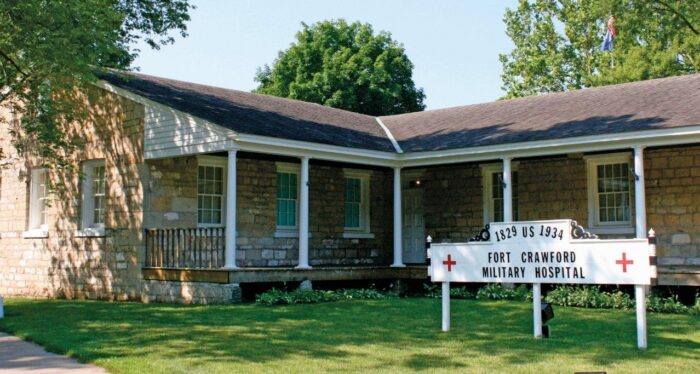
Fort Crawford Museum
717 South Beaumont Road – The second Fort Crawford Hospital was first occupied in 1831, with Dr. William Beaumont as the first surgeon. Zachary Taylor, Jefferson Davis, and Chief Black Hawk are also associated with the second Fort Crawford. Some tireless DAR women bought the site in the 1920s, and in the 1930s it was reconstructed as a WPA project. Until 1995 the site was known as The Museum of Medical Progress and was owned by the State Medical Society of Wisconsin. Since 1995 the museum has been owned and operated by the non-profit Prairie du Chien Historical Society. Today it is open daily as a museum from May through October. National Historic Landmark and National Register of Historic Places.
St. Germain dit Gauthier House
The house was built during the time of the Wisconsin Territory, prior to 1848. For the first several years of its existence, it belonged to Québécois immigrants. It originally belonged to Jean Baptiste Caron. Later, it was bought by Guillaume St. Germain. He and his wife, who has been named as either Madeline or Magdelaine, moved into it.
In 1890, Nina Dousman McBride bought the house. She rented it out to Charles Gremore. Gremore later bought the house and moved it to its present location, on an island in the Mississippi River in the late 19th or early 20th century. In 1902, George Coorough purchased it. An addition was added in 1916. The house remained in the Coorough family until 1978, when it was acquired by the City of Prairie du Chien.
It was added to the State Register of Historic Places in 2017 and to the National Register of Historic Places the following year.
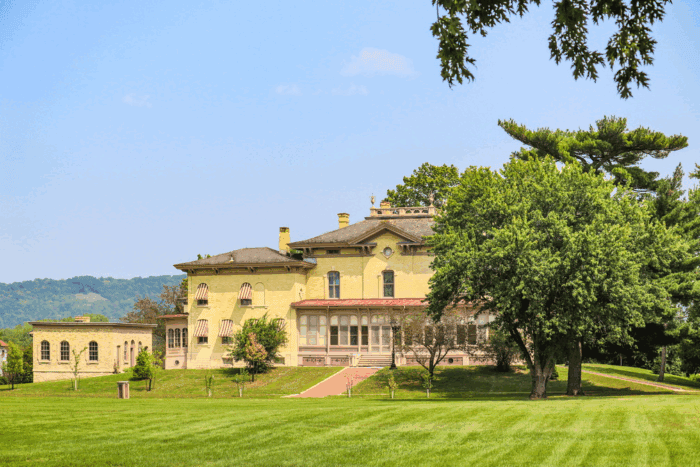
Villa Louis
(St. Feriole Island) Villa Road and Bolvin Street – This Victorian estate was home to three generations of the Dousmans. The estate was first developed in the 1840s by fur trader and frontier entrepreneur Hercules Dousman. The prominent mound was first built by Indians and later modified by several military installations. The estate offered both an elegant and a flood-proof setting. The present residence was built in 1870 by Dousman’s son, H. Louis Dousman. The family closed the estate in 1913 but returned 20 years later to establish the home as one of the first historic house museums in the midwest. The property became Wisconsin’s first State Historic Site in 1952. it is open as a museum every daily from May to October. The site retains its original furnishings, and since 1995 it has been extensively restored to its 1890s elegance as a National Historic Landmark and National Register of Historic Places.
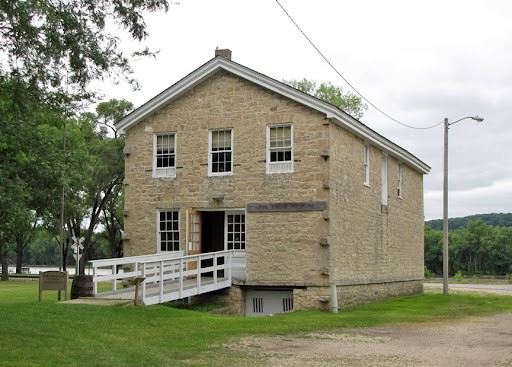
Brisbois Store – Fur Trade Museum
(St. Feriole Island) Water Street – Built in 1851-52 by fur trader and merchant, B.W. Brisbois, this stone building sits on land having a long association with the North American fur trade. Prior to the War of 1812, the property was owned by a number of prominent traders and companies. During the war, a log structure on the property was used by U.S. soldiers for housing while nearby Fort Shelby was under construction. After the war, the property became the site of a U.S. Fur Factory. In the 1820s the land was sold to the American Fur Company who held it until its sale to Brisbois in 1850. Through much of the twentieth century the building was known as the Riverside Boat Repair. The Wisconsin Historical Society acquired the building in the 1970s and established the Fur Trade Museum. Operated in conjunction with the Villa Louis, the building is open May through October as a National Historic Landmark and National Register of Historic Places.
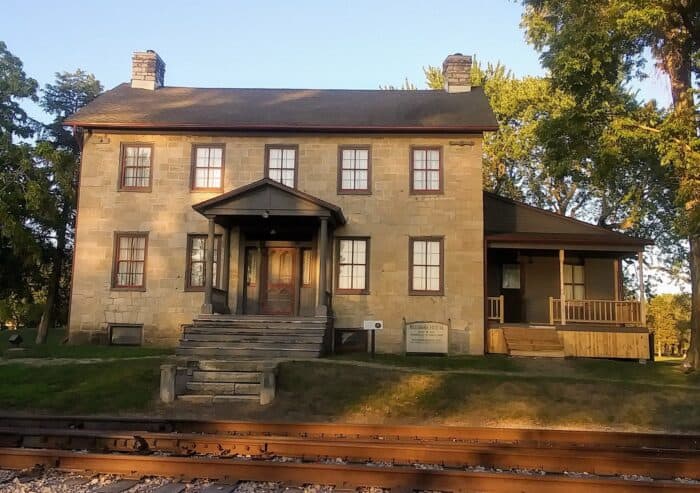
Brisbois House
(St. Feriole Island) Water Street – As part of a separation contract negotiated in 1836, Joseph Rolette agreed to build this stone residence for his estranged wife Jane Fisher Rolette. Built from surplus limestone sold by the government after the construction of Fort Crawford, the house was erected on property owned by Jane’s maternal relatives, the Brisbois. After Joseph Rolette’s death, Jane married his business partner, Hercules Dousman, and moved to the famed House on the Mound. Jane transferred the property to her cousin, B.W. Brisbois, and the house remained in his family until the end of the 1900s. In the 1950s the Cornelius family restored the residence and gave the property to the State Historical Society. Today it is operated in conjunction with the Villa Louis as a National Historic Landmark and National Register of Historic Places.
Rolette House
(St. Feriole Island) Water & Fisher Streets – In December 1840, Joseph Rolette began construction of this frame house. Unfinished upon Rolette’s death in 1842, the house was purchased by its builder, Henry Brandes. In the 1870s it was extensively remodeled, becoming a hotel, then a boarding house. Restoration of the house to its 1840s character is not complete. National Register of Historic Places.
The Dousman House Hotel
(St. Feriole Island) Fisher Sreet – The Railroad House was touted as the premier hotel on the Upper Mississippi when it was built by the railroad in 1864. Since Hercules Dousman owned so much of the railroad stock, the hotel was renamed after him in 1867. In the 1940s it was converted to a meat packing plant and later served as a warehouse. The property is undergoing redevelopment. National Historic Landmark and National Register of Historic Places.
St. Feriole Island
The island is the site of the city’s earliest activities: the center of the fur trade, home of the first Fort Crawford, site of the Battle of Prairie du Chien in 1814, and three important Indian treaties. Today St. Feriole Island hosts several major annual attractions and many small family outings. The third week in June is when the Prairie Villa Rendezvous is held. In July the Chamber of Commerce Fireworks, War of 1812, and the Prairie Dog Blues Fest draws crowds. The Carriage Classic brings an elegant equestrian style to the island in September.
Lawler Park
(St. Feriole Island) Water Street – In the early fur trading days, canoes landed on this beach. In the 1930s the WPA constructed the stone retaining wall and filled the shoreline with dirt. This favorite park was named for John Lawler, the builder of the famed pontoon railroad bridge. Visitors can enjoy the Walk of History, a series of 10 marble etchings telling highlights of Prairie du Chien’s past.
Calvary Cemetery
Located several miles north on Frenchtown Road (County Hwy K) across from Old French Cemetery. Hercules Dousman deeded the land to St. Gabriel’s before the Civil War. The prominent Dousman plot is near the center of the cemetery.
Old French Cemetery
Located several miles north on Frenchtown Road (County K) is the old burial ground. The first recorded burial was 1817. Basil Giard and Joseph Rolette are buried here. Records are at St. Gabriel’s.
Historical Resources
- Fort Crawford Museum 608-326-6960
- Villa Louis Historic Site 608-326-2721
- Prairie du Chien Public Library 608-326-6211
- Crawford County Clerk 608-326-0200
- Wisconsin Room – University of Wisconsin-Platteville, Karrmann Library, Platteville
- Lower Wisconsin River Genealogical & Historical Research Center, PO Box 202 Wauzeka, WI 53826-0202